
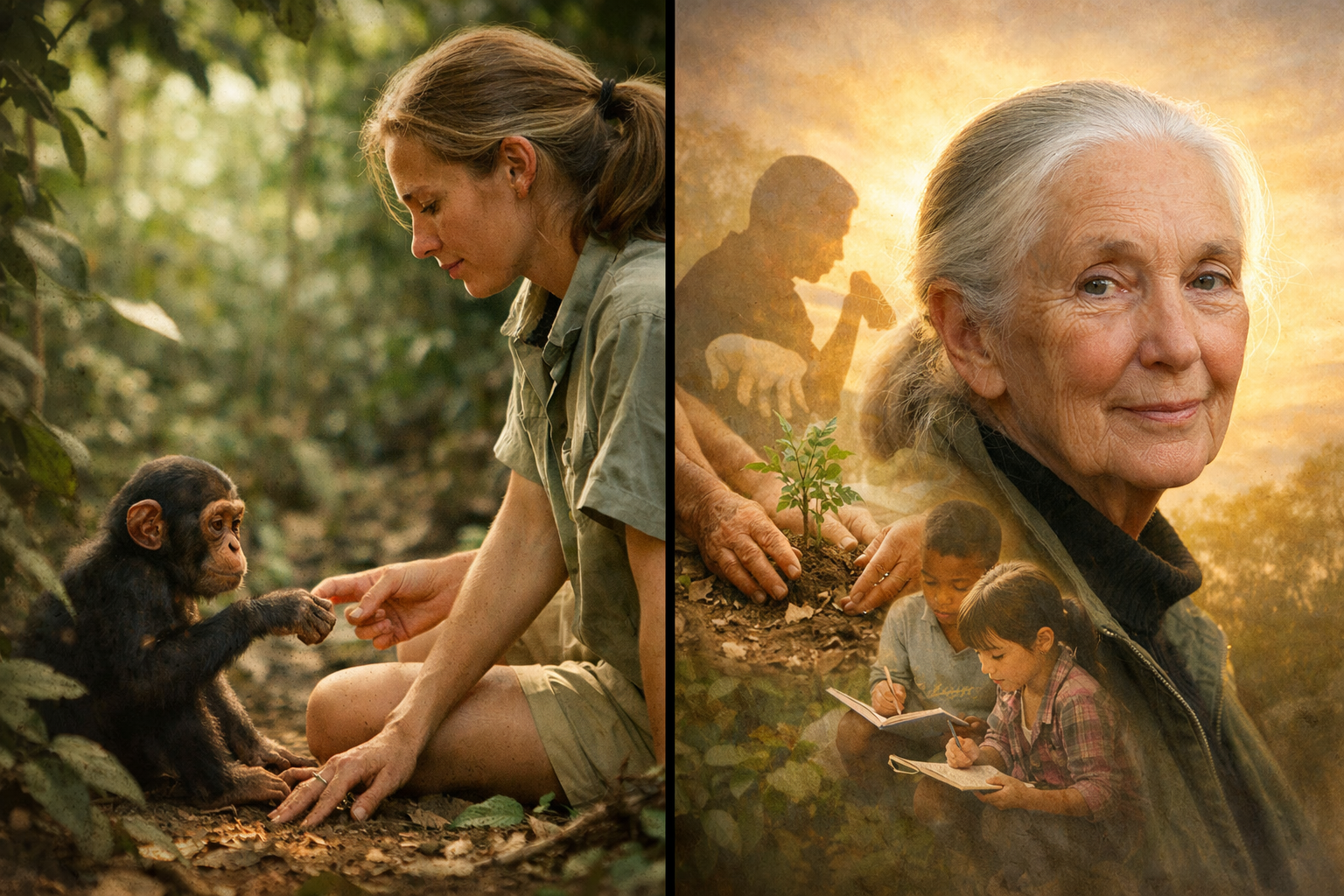
On October 1, 2025, the world lost not only a great scientist, but also one of the rare voices who endowed science with a conscience. When Jane Goodall’s life journey-begun in London on April 3, 1934-came to an end, what remained was far more than numbers, charts, and academic papers. She left behind a powerful moral legacy that compels us to rethink humanity’s relationship with nature, animals, and our own inner voice. She was a sage who could unite knowledge with compassion and science with responsibility.
A Different Path to Science
What made Jane Goodall extraordinary was that she did not enter science using conventional keys. When she went to Gombe National Park in Tanzania in 1960 without any academic title, she carried with her only curiosity, patience, and deep respect. Her years of quiet observation revealed that chimpanzees use tools, form complex social relationships, and display emotional responses such as affection, rivalry, and even violence. These findings fundamentally challenged the long-held belief that the qualities defining humanity belong exclusively to humans. Goodall showed how fragile the thick line drawn between humans and animals truly is.
Science as Stewardship
Yet to remember Jane Goodall merely as a great scientist would be to tell only part of her story. She was a symbolic figure who viewed science not as a display of power, but as a field of responsibility. She persistently emphasized that humanity’s relationship with nature is not about domination, but about stewardship. She reminded us that humans do not stand against nature, but exist within it and alongside it. In doing so, she brought together the cold objectivity of science with profound moral sensitivity.
Education: Awakening Empathy
Goodall’s ideas also resonate strongly in the field of education. For her, the purpose of education is not merely to transmit knowledge, but to cultivate awareness. Education should nurture empathy, curiosity, and a sense of responsibility. She argued that children should learn about nature not by memorizing pages from books, but by experiencing and observing it directly. In education, students should be taught not what to think, but how to think. This approach is especially powerful in values education and experiential learning. Through education, humans should come to realize that they are not masters of nature, but its trustees.
Ethics Beyond Anthropocentrism
Jane Goodall’s ethical perspective constitutes a clear and courageous critique of human-centered (anthropocentric) thinking. In her view, humans are not the pinnacle of nature, but an inseparable part of it. Power does not grant the right to exploit; it imposes the responsibility to protect. Animals, too, have pain, emotions, and social bonds, and this reality confronts humanity with a serious ethical reckoning.
“It is not how much we dominate nature, but how much we protect it, that makes us human.”
Leadership and Hope
This approach serves as a strong moral reference point in the fields of animal rights, environmental ethics, and scientific ethics. Her understanding of leadership is another dimension that sets Goodall apart. She does not define leadership as speaking loudly, but as maintaining a quiet yet determined moral stance. Leadership, for her, is not about imposing power, but about inspiring others. Change does not flow from the top down; it begins at the grassroots. By viewing young people not as passive listeners but as active agents of change, this approach forms the ethical foundation of the transformational leadership model widely discussed today.
Responsible Hope
When it comes to environmental awareness, Goodall does not rely on a language of fear and catastrophe. What she advocates instead is “responsible hope.” Hope is not a passive expectation, but a call to action. She believes that small individual steps can become the starting point of great collective transformations. She sees young people not as helpless victims of the environmental crisis, but as strong actors in the solution. The idea that “there is no hope without action” provides a powerful moral foundation for sustainability education.
Jane Goodall’s legacy today lives not only in scientific texts, but in the human conscience itself. She taught us that knowing alone is not enough; understanding, feeling, and taking responsibility are inseparable parts of being human.